Complete Puppy Vaccine Schedule: 6 Weeks to 1 Year
Which vaccines your puppy needs and when: core and non-core shots, a week-by-week schedule from 6 to 16 weeks, rabies rules in Nigeria and the 1-year booster.
In this article
- Core versus non-core: what vaccines your puppy actually needs
- The four vaccines every Nigerian puppy must have
- Non-core vaccines worth asking your vet about
- The week-by-week puppy vaccine schedule: 6 to 16 weeks
- 6 to 8 weeks: the first round of shots
- 10 to 12 weeks: the second dose
- 14 to 16 weeks: completing the puppy series
- Rabies vaccination in Nigeria: timing and what the law says
- When to give the first rabies shot
- Booster requirements after the first rabies dose
- Booster shots after the puppy series: the adult schedule
- The 1-year booster: why you cannot skip it
- The long-term schedule for adult dogs
- What to expect after your puppy's vaccination visit
- Normal reactions and how long they last
- Warning signs that need emergency vet care
- Preparing for each vet visit and keeping vaccination records
- What to bring and what to ask at each visit
- Tracking your puppy's vaccination history
- Start the schedule now and stay consistent
When you bring home a new puppy, one of the first questions you face is: what exactly is the puppy vaccine schedule, and which version should you follow? Within the first week, three different WhatsApp groups have given you three different lists of "injections your puppy needs." One neighbour says vaccinate at six weeks, another says eight weeks. A family member insists the vet near them does it differently. Nobody agrees on what the shots are called or how many are required. Meanwhile, your puppy is growing fast, exploring everything, and you are not sure whether any of that exposure is putting her at risk.
It is a stressful position to be in, and the stakes are not small. Canine parvovirus and distemper kill puppies. Both diseases are present in Nigerian urban environments, and puppies without proper immunisation have almost no defence against them. Getting the vaccination schedule right is one of the most consequential decisions you will make in your puppy's first year of life.
Before anything else, you need a reliable vet. PetMap's directory lists manually reviewed veterinary clinics in Lagos, Abuja, Port Harcourt, and other Nigerian cities, making it easier to find a qualified provider close to you without relying on word-of-mouth alone. Once you have that vet, this article gives you everything else: a complete, vet-aligned puppy vaccine schedule from six weeks through to the first year, the difference between core and non-core vaccines, what to expect after each visit, and how to maintain proper records. Follow this schedule consistently, and you give your puppy the strongest possible foundation.
Core versus non-core: what vaccines your puppy actually needs
Core vaccines go to every puppy regardless of where they live or how they spend their days. Non-core vaccines are given based on specific risk factors: lifestyle, environment, exposure to other animals, or local disease prevalence. Understanding this distinction matters because it explains why the puppy vaccine schedule is structured the way it is, and it makes the conversation with your vet far more productive.
The four vaccines every Nigerian puppy must have
The core vaccines for puppies in Nigeria are canine distemper, canine parvovirus, canine adenovirus (which protects against infectious hepatitis), and rabies. Distemper attacks the respiratory, gastrointestinal, and nervous systems and has no cure once advanced. Parvovirus is highly contagious and kills rapidly through severe gastrointestinal destruction. Canine adenovirus causes infectious hepatitis and can lead to liver failure.
Rabies is fatal, zoonotic, and legally required in Nigeria. None of these are optional. In Nigeria's dense urban environments, where dogs encounter other animals, contaminated soil, and shared public spaces regularly, the exposure risk for all four is real and consistent.
Non-core vaccines worth asking your vet about
Leptospirosis deserves a serious conversation with your vet, particularly if you are in Lagos. The disease spreads through water contaminated by infected animal urine, and Lagos's chronic flooding and rodent population create a genuine leptospirosis risk. Veterinary bodies such as the WSAVA have moved leptospirosis toward core status in flood-prone tropical environments, and your vet can assess your puppy's specific situation and advise accordingly. Bordetella (which causes kennel cough) and canine parainfluenza are also worth discussing if your puppy will spend time in boarding facilities, doggy daycare, or regularly interact with large groups of other dogs.
The week-by-week puppy vaccine schedule: 6 to 16 weeks
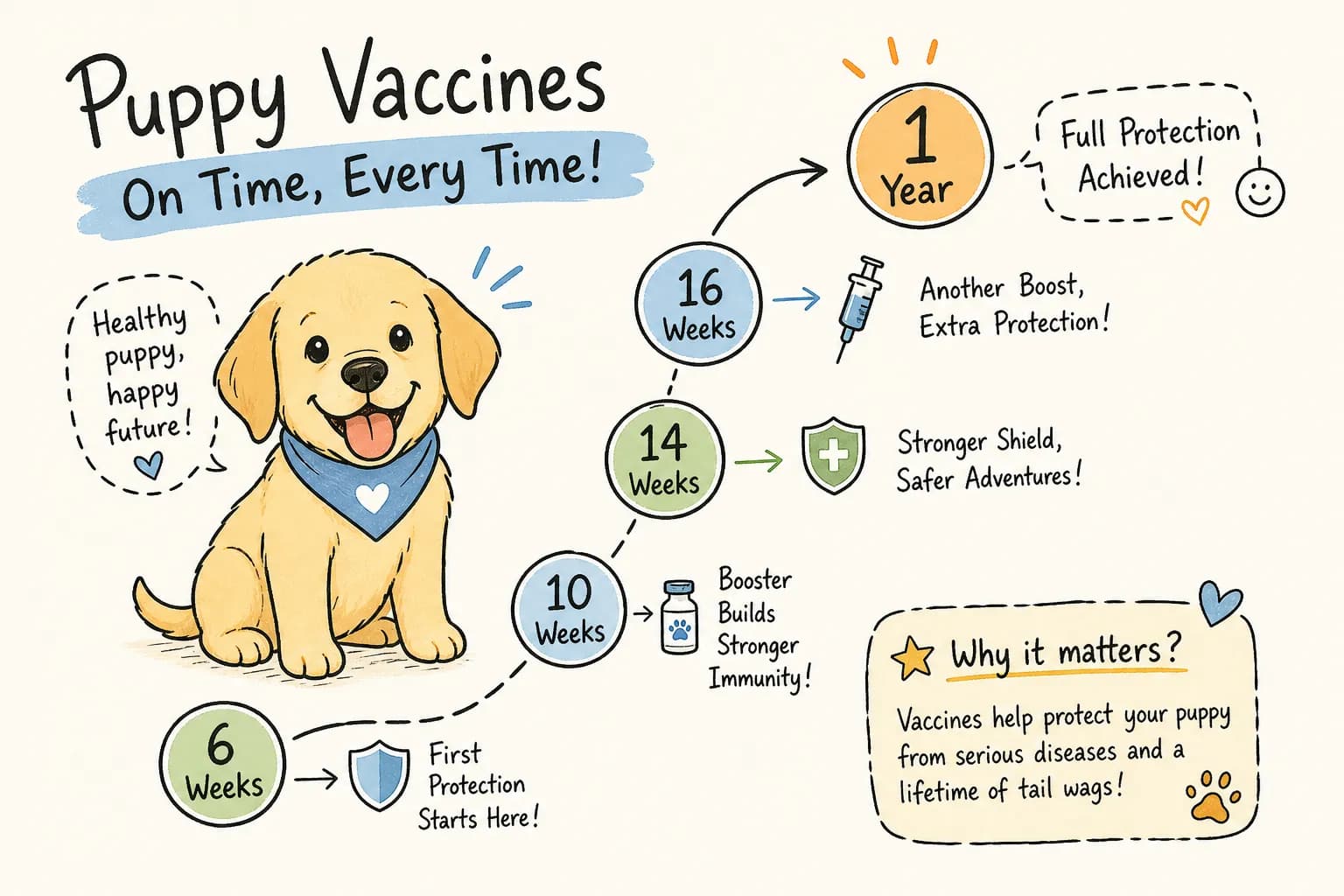
The reason puppies need multiple doses of the same vaccine is not because one dose is ineffective. It is because maternal antibodies, passed from the mother, partially block the vaccine's ability to generate a full immune response in the first weeks of life. As those antibodies wane, the vaccine can do its full job. That is why a series of doses spaced two to four weeks apart is the standard protocol, and why skipping doses undermines the entire effort.
6 to 8 weeks: the first round of shots
The first vet visit sets the foundation. Your puppy will receive the first dose of the DHPP or DAPP combination vaccine, covering distemper, hepatitis (adenovirus), parvovirus, and parainfluenza. Many Nigerian vets also include deworming at this visit, since intestinal parasites are common in young puppies and can affect their overall health and immune response. The vet will conduct a general physical examination and record your puppy's baseline weight. At this stage, maternal antibodies are still present and may partially block the vaccine, which is precisely why the next doses are necessary.
10 to 12 weeks: the second dose
The second DHPP booster arrives two to four weeks after the first. If your vet has assessed your puppy as having an elevated leptospirosis risk based on local environment and lifestyle, the leptospirosis vaccine is often introduced at this stage. This is also the period when many puppies become noticeably more curious and social, which makes the timing particularly important. A puppy now sniffing around parks, meeting other dogs, and exploring outdoor spaces faces increasing exposure to parvovirus. The second booster builds on the first dose and begins to establish a more robust immune response.
14 to 16 weeks: completing the puppy series
The final dose of the puppy DHPP/DAPP series is given at 14 to 16 weeks. By this point, maternal antibodies have typically waned enough for the vaccine to generate a full, independent immune response. This visit is also when most Nigerian vets administer the first rabies vaccine, which should not be given before 12 weeks of age. In higher-risk environments, or where maternal antibody interference is a specific concern, the final DHPP dose may be extended to 16 to 20 weeks. Your vet will make this call based on your puppy's individual circumstances.
Rabies vaccination in Nigeria: timing and what the law says
Rabies remains a genuine public health concern in Nigeria, and the vaccination requirement for dogs is not a formality. It is both a legal obligation and a direct public health measure, enforced through state veterinary services and local licensing authorities. State-level Dogs Laws in Nigeria treat rabies vaccination as a condition for dog ownership and licensing, and proof of vaccination may be requested by regulatory authorities.
When to give the first rabies shot
The first rabies dose must be given at or after 12 weeks of age. Administering it earlier is not recommended because the puppy's immune system has not yet matured sufficiently to generate a reliable response, and maternal antibodies may still interfere. In practice, most Nigerian vets schedule the rabies shot during the 14 to 16 week visit, which aligns neatly with the final DHPP booster. Dogs from approximately three months of age are classified as vaccination-eligible under Nigerian veterinary and public health guidelines.
Booster requirements after the first rabies dose
A booster is required one year after the initial rabies dose. After that, the frequency depends on which vaccine product your vet uses. Annual rabies products require yearly boosters; three-year products move to a triennial schedule after the one-year booster. Ask your vet directly which product they are administering, note it on your vaccination card at the time of the visit, and set a reminder so you do not miss the booster window. This is a detail that many owners overlook, and it matters for both your dog's protection and regulatory compliance.
Booster shots after the puppy series: the adult schedule
Completing the puppy series at 16 weeks builds the immune foundation your dog needs, but the booster shots that follow are what sustain it. Without them, that protection fades over time. Some owners assume the early shots are sufficient and delay or skip adult boosters, leaving their dogs with reduced or lapsed protection without realising it.
The 1-year booster: why you cannot skip it
One year after completing the puppy series, your dog needs booster doses for DHPP/DAPP and rabies. Think of the one-year booster as a confirmation shot: by this point, maternal antibodies are completely gone, and the immune system is fully capable of generating and retaining its own protective response. The booster confirms and consolidates that protection. Skipping it is a common vaccination mistake among pet owners, and one that undermines everything the puppy series worked to establish.
The long-term schedule for adult dogs
After the one-year booster, distemper, parvovirus, and adenovirus vaccines typically move to a triennial schedule, meaning every three years. Leptospirosis, if it is part of your dog's protocol, generally remains annual because its protection duration is shorter. Your vet will issue an updated vaccination card at the one-year visit that maps out the adult schedule going forward. Keep it safe, boarding facilities, groomers, and any future vets will ask for it, and it is your clearest proof of compliance with Nigeria's rabies vaccination requirements.
What to expect after your puppy's vaccination visit
Post-vaccination anxiety is common among new puppy owners. Knowing what is normal and what is not removes most of that worry. Mild reactions after vaccination are expected; they are a sign that the immune system is responding. Severe reactions are rare, but they require immediate action.ht soreness or swelling at the injection site, and a mild fever. If y
Normal reactions and how long they last
Common mild effects include lethargy, reduced appetite, sligour puppy received an intranasal vaccine, mild sneezing or a light nasal discharge is also normal. These effects typically appear within a few hours of the shot and resolve within one to two days. For the rest of the day after vaccination, let your puppy rest, ensure access to fresh water, and avoid strenuous play or exercise. Local swelling at the injection site can occasionally persist for a few days longer, but should reduce progressively.
Warning signs that need emergency vet care
Go to a vet immediately if you see any of the following: facial or muzzle swelling, hives on the skin, vomiting, difficulty breathing, collapse, pale gums, or extreme weakness. These are signs of a serious allergic reaction, and they do not wait. Severe reactions typically occur within minutes to a few hours of the shot, which is why some vets recommend keeping your puppy at the clinic for 15 to 20 minutes after vaccination. Do not delay or wait to see if symptoms improve on their own, seek emergency vet care straight away.
Preparing for each vet visit and keeping vaccination records
Knowing the schedule is half the work. Executing it consistently is the other half. A little preparation before each visit and a disciplined approach to record-keeping will save you from missed appointments, repeated starter doses, and scrambling for paperwork at the worst possible moments.
What to bring and what to ask at each visit
Bring your puppy's vaccination card from the previous visit, a note of any deworming treatments given at home, and observations about any changes in behaviour, appetite, or environment since the last appointment. At each visit, ask your vet which vaccine brand is being used, what the booster interval is for that specific product, whether deworming is included, and when you should return for the next dose. These are not intrusive questions, they are exactly the information you need to manage your puppy's health correctly.
Tracking your puppy's vaccination history
Your vet should provide a physical vaccination card after each visit. Keep it somewhere consistent and photograph it after every visit as a digital backup on your phone. Boarding facilities commonly require it before accepting your dog, and many groomers ask for it too. If you ever switch vets, it is the first document your new vet will want. Nigeria's rabies regulations also mean that proof of vaccination may be requested, so having a clear record readily available matters. If you are still looking for a verified vet to begin or continue your puppy's vaccination schedule, PetMap's directory lists manually reviewed clinics across Lagos, Abuja, and other Nigerian cities, so you can find a qualified provider close to you.
Start the schedule now and stay consistent
Following a complete puppy vaccine schedule from six weeks through year one is one of the highest-impact decisions you will make as a pet owner. The first shots go in at six to eight weeks. Two more rounds complete the core series by 16 weeks. The rabies vaccine comes in at 12 weeks or later, during the final puppy visit. Then the one-year booster arrives twelve months after the series ends, cementing your dog's long-term protection. Think of this puppy shots schedule as a series of appointments with compounding value, each one builds on the last.
The schedule is not complicated, but it does require follow-through. Book the first vet appointment as soon as your puppy is six weeks old, or as soon as you bring her home if she is older. Keep the vaccination card safe from the very first visit, and set reminders on your phone for each subsequent dose. A puppy who completes the full immunisation timetable, including the adult boosters, carries protection that lasts years. One who misses doses carries gaps that you may never detect until it is too late. Stick to this puppy vaccine schedule, and you give your dog the best possible start to life.
This article is general information, not a diagnosis. If your pet is unwell, speak to a vet.
Veterinary near you
Contact details, opening hours and directions for veterinary listings across Nigeria.
Browse Veterinary